Whatever your specialisation, accurately prescribing resistance exercise should be a priority.
Overview of the course
Historic myths and misunderstandings, together with the industry’s current over-reliance on cables, stability balls and so called ‘functional exercises’, often results in individuals never fully realising the significant benefits of resistance training.
This course sets out to dispel many of the popular myths, discuss the relevant scientific evidence and develop mastery of the necessary practical skills.
The various components of strength and the factors that influence muscular strength are discussed. A rationale for comprehensive assessment is outlined and a tool-kit of validated assessment techniques is explained, along with the application of the results.
Programming considerations, for strength, endurance and power are discussed together with those for many of the commonly encountered clinical conditions. The latest resistance training guidelines for the elderly and children are also covered.
To ensure you are proficient in delivering inspirational results beyond the initial 12 weeks, an entire day is allocated to conveying the complex principles of periodisation.
An array of advanced training techniques are demonstrated along with many alternative exercises and modes of resistance.
Throughout the course there is ample opportunity to practice the skills and discuss how the science is applied to real life situations.
Discussions about over training, breaks in training, unstable surface training, functional isometrics and controversial exercises complete this balanced view on a vital component of fitness.
This course is a must for any instructor looking to improve health and/or athletic performance.
Content
This course covers the following:
- Adaptations and responses to resistance training
- Factors that influence strength
- Methods for assessing muscular strength and endurance
- Alternative modes of resistance training, i.e. cables and medicine balls
- Theory and application of advanced training techniques, such as complex and contrast training, functional isometrics, drop sets, etc
- Advanced programme design and periodisation
- Detraining, re-training and over-training
- Manipulation of programme variables to optimise hormonal response to training
- Programme adaptations for special populations
- The set debate: Is one set really enough? Is there an optimal number of sets?
- Analysis of controversial exercises
- Use of unstable surfaces
Accreditation and assessment
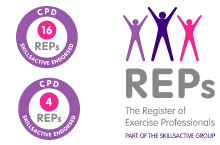
Advanced Resistance Training for Health and Performance is recognised by the Register of Exercise Professionals (REPs) as continuous professional development (cpd).
Attending this course can achieve 16 cpd points. As the course provides both knowledge and skills, there is a practical assessment, a multiple choice assessment and a case study to be submitted within 30 days of attending.
Distance learning of the resource manual, to enhance knowledge of the subject, requires about 24 hours of self-study. 4 cpd points can be achieved. There is a multiple choice assessment on completion.
Students are welcome to both attend and self-study the same course, achieving 20 (16+4) cpd points. The self-study element serves to reinforce the knowledge component.
Pre-requisites
Course attendance is suitable for Level 3 instructors, as recognised by the Register of Exercise Professionals.
Self-study of the resource manual is suitable for Level 2 instructors, or above, as recognised by the Register of Exercise Professionals.
Those who are not members of the Register of Exercise Professionals are also welcome to attend.